
How to Enable and Add Supports in Anycubic Slicer
June 19, 2026
Turn on support generation in Anycubic Slicer Next, tune the support type and overhang threshold, and add or block supports by hand. A practical, step-by-step guide.
Supports are off by default in Anycubic Slicer Next. Slice a model with steep overhangs without enabling them and those overhangs print into thin air. Turning supports on is a single checkbox on the Support tab. This guide covers enabling automatic supports, the settings that matter, and adding or removing supports by hand.
Enable support
In the Process panel on the left, click the Support tab (alongside Quality, Strength, Multimaterial, and Others). The first option is Enable support. Tick it.
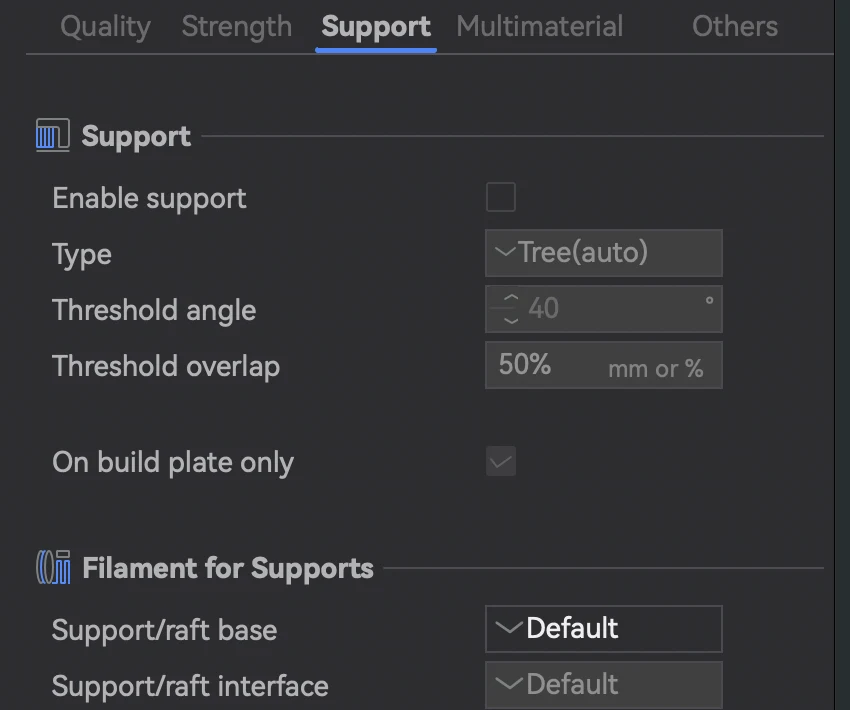
Notice that every setting below is greyed out in the screenshot above. That is the default state: until Enable support is checked, none of the other support options do anything. This is the answer to "why won't my support settings change" more often than not.
The settings that matter
Once support is enabled, these are the controls on the Support tab:
- Type decides how supports are built. Tree (auto) (the default) uses branching organic supports that use less material and peel off cleaner on figures and curved models. Normal (auto) is the dependable grid that is more stable under large flat overhangs.
- Threshold angle (40 by default in Anycubic Slicer) is the single most useful dial. Any overhang steeper than this angle from vertical gets supported. Lower it and you support only the most extreme overhangs; raise it and the slicer supports more aggressively. If a print needs supports in places you did not expect, this is usually why.
- Threshold overlap sets how far the supports overlap the surface they hold up.
- On build plate only restricts supports to those that rise from the bed, never from the model surface. Use it when model-on-model supports would scar a visible face.
For more support options, including Style (how closely supports hug the model), first-layer density, and ignore small overhangs, turn on the Advanced toggle at the top of the Process panel. The simplified default view hides them.
Adding or removing supports by hand
Automatic supports are all-or-nothing based on the threshold. When you want control over specific areas, use the Support painting tool on the toolbar to the left of the 3D view. It gives you two brushes:
- Support Enforcer paints regions that must be supported even if the auto rules would skip them.
- Support Blocker paints regions that must never be supported, even if they qualify, so you can keep supports off a delicate or hard-to-reach face.
This is the right tool when a model is 95% fine on automatic supports but has one spot you want to force or protect.
Supports across a farm
Dialing supports per model is part of preparing a print. The friction starts when you are running the same parts across many machines and re-slicing by hand for each one. Printago slices in the cloud using the same OrcaSlicer engine Anycubic Slicer Next is built on, so a part's support configuration travels with it to whatever printer is free. See cloud slicer for how that works, and the Anycubic Slicer overview for the rest of the software.
More Anycubic Slicer guides
Read the Anycubic Slicer overview, or browse all slicer guides.
Frequently asked questions
Sign up for free today
No credit card required. Connect unlimited printers and get production automation running in minutes.