
Alternative
Bambuddy vs Printago: Self-Hosted Bambu Print Management Compared
Reviewed June 26, 2026
Bambuddy vs Printago for managing Bambu Lab printers. Self-hosted open-source control versus a maintained cloud platform with order-to-print automation, plus the trade-offs of running everything yourself.
Overview
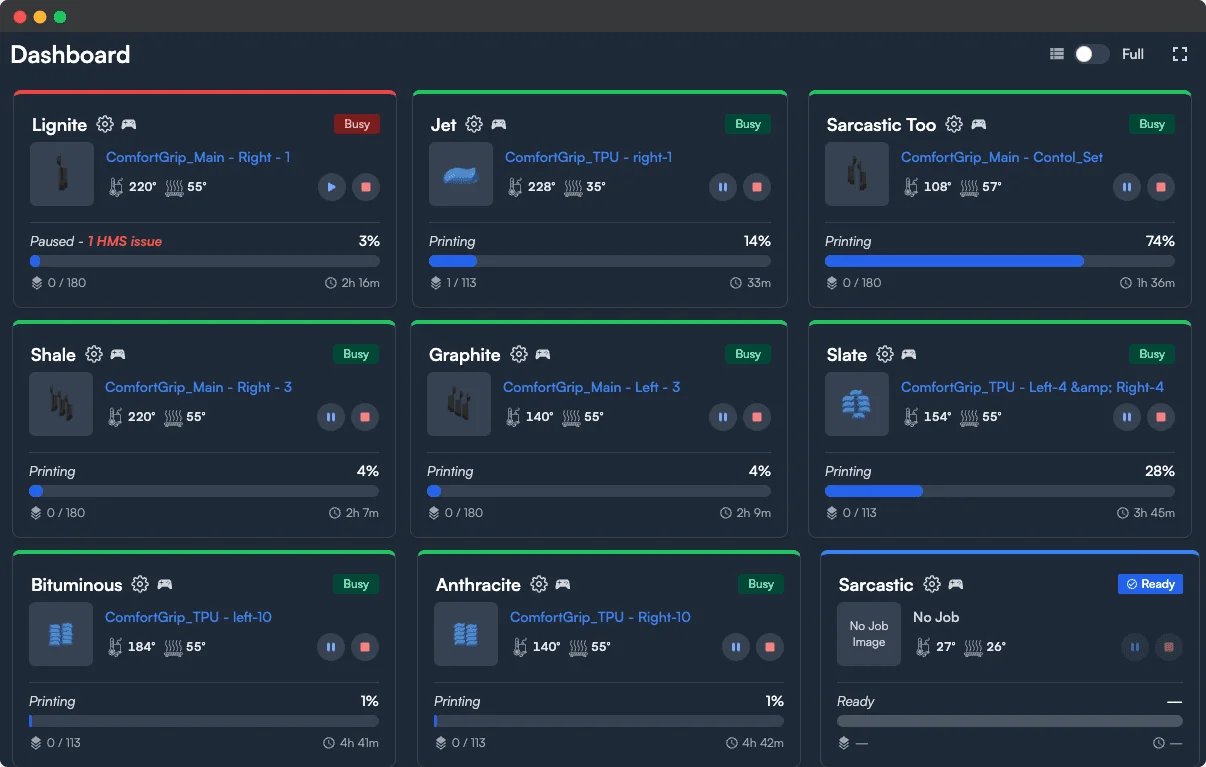
Bambuddy and Printago both give you a central command center for Bambu Lab printers, with live monitoring, print archives, queueing, and notifications. They differ on the question underneath all of that: who runs and maintains the software.
Bambuddy is an open-source, self-hosted application for Bambu Lab printers. It keeps every piece of data local with no cloud dependency, and it is genuinely impressive for a free project: 3MF archiving, a searchable print log, an in-browser 3D model viewer, integrated headless slicing, AMS humidity charts, Spoolman sync, proxy-mode remote printing, and an NFC spool-identification companion. If your priority is keeping your printer data entirely on your own hardware and you enjoy running infrastructure, it is one of the most capable Bambu-only tools in the community.
Printago is a maintained cloud platform that covers fleet management and adds the workflow above the printers: cloud slicing, SKU and variant mapping, native Shopify and Etsy workflows, parametric model generation, and a queue tied to real orders. You connect printers and use it; the hosting, upgrades, and data durability are Printago's responsibility, not yours.
Self-hosted means absolute control and absolute responsibility
This is the heart of the comparison, and it cuts both ways.
Self-hosting gives you absolute control. Your data never leaves your network, there are no external accounts, no subscription, and you can modify the source. For operators with strict data-residency rules or a strong preference for local-only operation, that is the whole point, and it is a real advantage.
The flip side is absolute responsibility. With Bambuddy, you are the operations team. You provision the server (a Raspberry Pi, NAS, or mini-PC), pick and run the database (SQLite or PostgreSQL), keep Docker healthy, configure the networking so the container can reach your printers, manage your own backups, apply security patches, and perform every upgrade by hand. When something breaks during a production run, there is no support queue with an SLA; the community Discord and GitHub issues are where you go for help.
None of that is a knock on Bambuddy specifically. It is the nature of self-hosting. The question is whether running the infrastructure is a job you want, or a job you would rather not have.
Who carries the maintenance burden
Bambuddy is early, fast-moving software. As of this review it is on a 0.2.x release line with new builds every week or two, which is great for momentum but means you, the self-hoster, own the upgrade treadmill: reading each changelog, taking a backup before you update, and keeping current with fixes. Pre-1.0 projects also do their security work in the open. Bambuddy patched a critical authentication-bypass vulnerability (CVE-2026-25505, CVSS 9.8) in v0.1.7, and to its credit handled it promptly and transparently. That is the normal, healthy lifecycle of young open-source software. The point is simply that on a self-hosted install, applying each fix in time is your job, not the maintainers'.
This is where a maintained platform is structurally different, and it is worth being explicit about the incentives. When Printago ships an update, it runs against every customer at once. A bad migration or a missed patch does not frustrate a single user, it costs us customers and trust at scale, so we are structurally forced to get safe migrations, backward compatibility, tested upgrades, durable backups, and security response right every time. With Bambuddy, the maintainers ship the code and you run it, so the work of upgrading safely, and the blast radius when an upgrade goes wrong, both land on you.
Neither model is better in the abstract. They put the responsibility in different places. The right choice depends on whether running that responsibility is something you want to own or something you would rather hand off.
Bambu only vs mixed fleet
Bambuddy is Bambu Lab only, covering the current Bambu lineup (the X1, P1, A1, and H2 lines, with newer models added as they ship), all in Developer Mode. This is a deliberate, permanent scope, not a temporary gap: the maintainer has signaled there is no intention to support printers from other brands. The name and tagline ("Your Bambu Lab. No Cloud. Your Rules.") say as much. If your shop is and will stay 100% Bambu, that focus is fine, and arguably a strength.
Printago manages Bambu Lab alongside Klipper (via Moonraker), Prusa (via PrusaLink), Snapmaker, Elegoo, and many other brands in one dashboard and one queue. Bambu printers connect directly when cloud-capable, or through the free Fuse local bridge in LAN mode. If a single non-Bambu machine ever joins your fleet, you keep one management layer instead of two.
E-commerce and production automation
This is the clearest functional difference.
Bambuddy manages prints. When a customer places an order on your Etsy or Shopify shop, Bambuddy does not know about it. There is no storefront integration, order sync, SKU mapping, or variant resolution. Someone still takes the order, finds the right file, slices it, and dispatches it. Bambuddy then handles the print and archives it.
Printago automates that translation. Orders arrive from your storefronts, map to SKUs and variants, resolve to the correct part files and materials, slice automatically, and queue on the right printer. For personalized products, parametric generation produces a per-order model before slicing, and FabMatic keeps printers running unattended. Operators handle exceptions, not routine jobs.
What about self-hosting Printago
If local-only operation is a hard requirement, Printago offers a self-hosted edition. It is built for enterprises with strict data-residency, compliance, or air-gap needs, and it comes with the same maintenance responsibilities any self-hosted system carries.
For a single printer or a small shop, that is usually the wrong tool. The cloud version delivers the full workflow, slicing, order automation, monitoring, and mobile access, with none of the server, database, or upgrade maintenance. Most individual users get everything they want from cloud mode and let Printago run the infrastructure. Self-hosting is there when you genuinely need it, not as the default.
Feature comparison table
| Feature | Printago | Bambuddy |
|---|---|---|
| Primary focus | Order-to-print automation | Self-hosted Bambu fleet management |
| Hosting model | Cloud (self-hosted edition for enterprise) | Self-hosted only |
| Who maintains it | Printago | You |
| Updates & migrations | Managed, tested, backward-compatible | You upgrade and migrate by hand |
| Backups & data durability | Handled by Printago | Your responsibility |
| Bambu Lab support | Yes | Yes |
| Non-Bambu fleet support | Yes | No |
| Cloud slicing | Headless and automated | Headless slicer sidecar (Docker) |
| Live monitoring & cameras | Yes | Yes |
| AMS / filament tracking | Yes | Yes, plus Spoolman sync |
| Native Shopify / Etsy workflow | Yes | No |
| SKU & variant mapping | Yes | No |
| Parametric model generation | Yes | No |
| Support | Maintained platform + support | Community Discord + GitHub issues |
| Price | Free tier + paid capacity | Free, open source (AGPL-3.0) |
Who should choose what
Choose Bambuddy if you run a Bambu-only fleet, want every byte of data on your own hardware, enjoy running and maintaining infrastructure, and are comfortable owning backups, upgrades, and the occasional breaking change between versions.
Choose Printago if you would rather connect printers and have the platform handle hosting, upgrades, and data durability, you run or might run mixed hardware, or your real bottleneck is the work between an online order and the right printer starting the right job.
Bottom line
Bambuddy is a genuinely capable, free, open-source tool for Bambu Lab printers, and self-hosting gives you total control over your data. The cost of that control is total responsibility: you run the server and database, you own the backups, and you carry the upgrade and security treadmill that comes with an early-stage project.
Printago takes the opposite stance. It is maintained, so safe migrations, durable data, and security response are our problem rather than yours, and it adds the order, SKU, slicing, and routing automation that a device-focused tool does not cover. If you specifically want to host everything yourself, Printago offers a self-hosted edition for enterprises, while single-printer and small-shop users get the full experience from cloud mode with no infrastructure to run.
Sources Reviewed
Frequently asked questions
Sign up for free today
No credit card required. Connect unlimited printers and get production automation running in minutes.